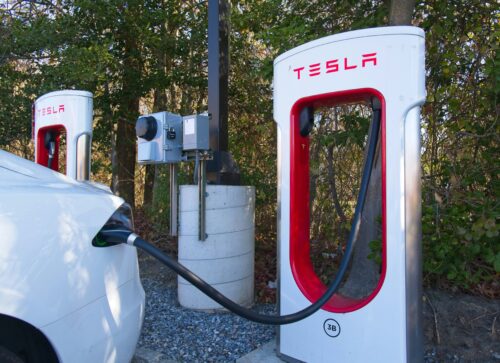
Tesla supercharger at a charging station.
One of the most common concerns about electric vehicles (EVs) is charging. Critics often point to long-distance travel or worries about finding a charger as reasons to stick with gasoline-powered vehicles. Yet the reality is changing rapidly. Across the country, charging infrastructure is expanding, technology is improving, and EV ownership is becoming increasingly convenient.
The vast majority of EV charging actually happens at home. Drivers can plug in overnight and wake up to a fully charged vehicle each morning. For people who drive typical daily distances, this often eliminates the need to visit a public charging station at all. For longer trips, public charging networks have grown significantly in recent years. Fast chargers are increasingly available along major highways, shopping centers, workplaces, parking garages, and retail destinations. These chargers can add substantial driving range in the time it takes to grab a coffee, eat lunch, or take a short break during a road trip.
Technology has also made locating chargers easier than ever. Smartphone apps and built-in vehicle navigation systems provide real-time information about charging locations, availability, charging speeds, and pricing. Finding a charger today is often as simple as searching for a nearby gas station.
Another major development is the growing flexibility between charging networks. Many newer EVs can access multiple charging systems, including portions of the extensive Tesla Supercharger network through adapters or native compatibility. This expanded access is helping reduce concerns about charging availability and increasing confidence among prospective EV buyers.
At the same time, automakers are introducing an ever-expanding range of EV options. Consumers can now choose from compact cars, family SUVs, luxury vehicles, pickup trucks, crossover models, and performance vehicles. Competition among manufacturers is helping improve features while driving innovation in battery technology and charging capabilities.
Despite this progress, challenges remain. Residents who live in apartments, condominiums, or dense urban areas may have limited access to home charging. Addressing these gaps will require continued investment in public charging infrastructure and creative solutions. Cities are beginning to explore curbside charging systems, which have already become common in many European communities. Public parking facilities, shopping centers, and workplace charging programs are also helping make EV ownership practical for people without dedicated driveways or garages.
Expanding charging access is not simply about convenience. It is about ensuring that the benefits of electric transportation are available to everyone. As infrastructure grows, consumers gain more confidence, adoption increases, and communities experience cleaner air and reduced dependence on fossil fuels.
The charging network of the future is already being built. Every new station, every upgraded charger, and every technological improvement helps make electric transportation more accessible. For many drivers, concerns about charging are becoming increasingly outdated as infrastructure catches up with demand.
The transition to electric transportation depends on more than vehicles alone. It requires a robust charging ecosystem that supports drivers wherever they live, work, and travel. Fortunately, that ecosystem is expanding faster than ever.