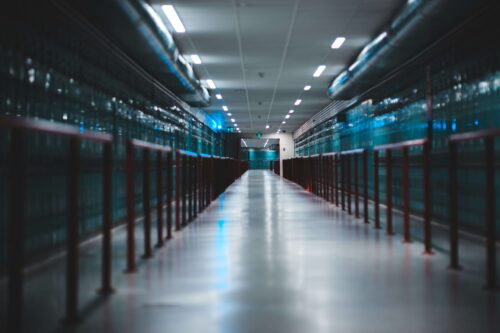
Photo by Erik Mclean on Unsplash
Every time you stream a movie, save photos to the cloud, use GPS or ask an AI chatbot a question, you’re relying on a data center.
Data centers are facilities filled with computer servers that store, process and transmit digital information. They support services we use every day, from banking and healthcare records to video calls and cloud computing.
But the rapid expansion underway today isn’t simply about maintaining those services. The AI boom is driving demand for larger and increasingly energy-intensive facilities—and that should prompt a basic question: How many data centers do we actually need, and what should communities be expected to give up to accommodate them?
A Growing Demand for Electricity
Data centers already consume a significant amount of electricity, and their footprint is expanding rapidly. According to the latest Lawrence Berkeley National Laboratory analysis, data centers could account for between 9.5% and 15.3% of U.S. electricity consumption by 2030.
That demand doesn’t exist in a vacuum.
When a massive new electricity user connects to the grid, additional power generation, transmission lines, substations and other infrastructure may be required. Without strong protections, households and businesses could end up facing some of the costs of an energy buildout driven by private technology companies.
Recent developments within PJM demonstrate just how serious the problem has become. In August, PJM proposed a framework that could require data centers and other large electricity users to reduce or shift their demand during grid emergencies before traditional customers face outages. PJM also reported a roughly 6.8-gigawatt shortfall against its reliability requirement in its recent capacity auction. Reuters reported on PJM’s proposal and reliability concerns here.
That’s particularly concerning at a time when New Jersey families are already struggling with high electricity bills.
What About the Water?
Electricity isn’t the only resource at stake. Servers generate enormous amounts of heat, requiring cooling systems that can consume significant amounts of water depending on a data center’s size, design, cooling technology and location.
The problem isn’t simply consumption; it’s whether communities have enough information to understand the potential consequences before approving a project.
Data center developers should be required to provide transparent information about where their water will come from, how much they expect to consume, what happens to that water after it is used and how their operations could affect local supplies.
New Jersey shouldn’t wait until a community’s water supply is under stress to ask those questions.
Economic Development for Whom?
Data centers are routinely presented as engines of economic development. But those claims deserve scrutiny rather than automatic acceptance.
Any promised tax revenue, construction activity, jobs or other economic benefits should be weighed against what communities are being asked to provide in return: electricity, water, land and potentially billions of dollars in supporting energy infrastructure.
That calculation becomes even more important if serving these facilities requires building new fossil fuel generation.
Instead of asking only how quickly New Jersey can attract data centers, policymakers should ask harder questions: How much energy will a proposed facility require? Where will that electricity come from? How much water will it use? Who pays for the necessary infrastructure? How many permanent jobs will it actually create? What are the local environmental consequences? And do the benefits outweigh those costs?
Growth Shouldn’t Be Automatic
Data centers provide infrastructure that modern society relies on. But that doesn’t mean every proposed facility is necessary, beneficial or deserving of public support.
New Jersey has an opportunity to establish clear standards before allowing widespread expansion of this industry.
Data center developers should demonstrate that their projects provide meaningful benefits to New Jersey, pay the costs associated with their enormous energy needs, protect local water supplies and bring new clean energy online to meet their demand.
The question shouldn’t be whether New Jersey can accommodate unlimited data center growth.
It should be whether individual projects are worth the resources they consume—and whether they can be built without asking New Jersey residents to pay the price.