 When people hear the term “power plant,” they often picture a large facility generating electricity from a single location. A virtual power plant works very differently.
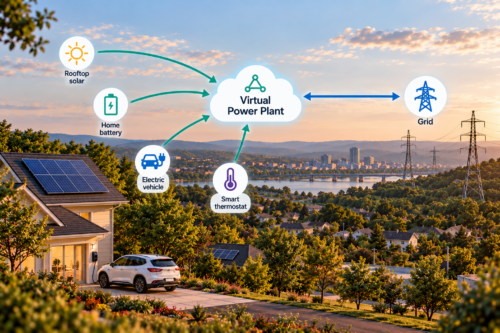
Rather than producing electricity at one central site, a virtual power plant (VPP) connects thousands of smaller energy resources—such as home batteries, rooftop solar panels, smart thermostats, electric vehicles and other flexible technologies—and coordinates them to operate as one.
Using advanced software, these distributed resources can respond together when electricity demand is high. Some devices temporarily reduce energy use, while others send stored electricity back to the grid. The result is additional capacity exactly when it’s needed most, without having to build a new traditional power plant.
Virtual power plants help make better use of energy resources that already exist. Instead of relying solely on large generators to meet peak demand, utilities can tap into a network of connected homes and businesses that voluntarily participate in helping balance the grid.
This approach offers several benefits. Virtual power plants can improve grid reliability, reduce strain during periods of peak demand and lower overall system costs by avoiding or delaying expensive infrastructure upgrades. They also make it easier to integrate renewable energy by storing excess electricity and delivering it when solar or wind production declines.
As electricity demand grows—driven by electric vehicles, building electrification, AI and expanding data centers—virtual power plants are becoming an increasingly important part of a modern energy system. They demonstrate how innovation isn’t always about building more infrastructure. Sometimes it’s about using the infrastructure we already have more efficiently.